
Timesheets and payroll
Working hours captured from shifts, ready for payroll and the two-year retention period.
At around 6 Mietwagen (German private-hire cars with driver), fleets run two shifts, and drivers, deadlines and records grow faster than the fleet. Timesheets and payroll break first, then HU, P-Schein and Konzession deadlines, dispatch, order records for the return-to-base rule, and cash. Fleet management software puts all of it, plus Uber and Bolt data, in one place.
Get an assessment for your fleet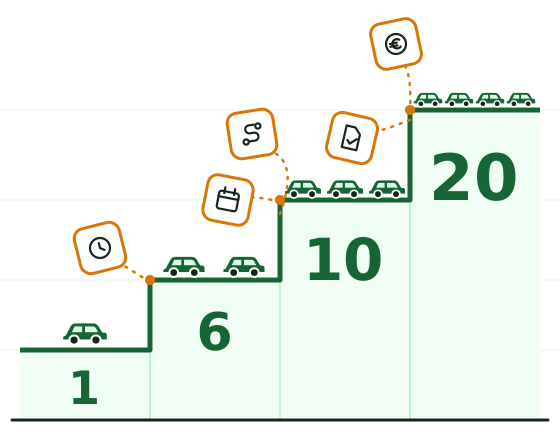
Every new car brings one or two drivers, and every driver brings shifts, hours and a P-Schein (the German passenger-transport licence) of their own. The table shows what typically stops working on the side at each stage.
| Process | From 6 carsapprox. 9 drivers, 2 shifts | From 10 carsapprox. 16 drivers, first office hire | From 20 carsapprox. 34 drivers, dispatchers on shifts |
|---|---|---|---|
| Timesheets and payroll | Shift notes arrive as WhatsApp photos; the owner adds them up at night. | The new office hire spends hours each week retyping and chasing drivers. | Payroll without a system becomes a part-time job of its own. |
| Deadlines | The owner still knows the HU dates by heart. | One spreadsheet that only one person maintains. If they are out, so is the list. | An expired P-Schein or a missed HU only shows up at a roadside check. |
| Dispatch | The owner forwards rides by phone. | One dispatcher, but requests from apps, phone and chat arrive separately. | Several dispatchers need the same view of drivers and orders. |
| Return-to-base proof | Orders are scattered across the platform apps. | Nobody can quickly show when an order reached the base. | A year of records for dozens of drivers is hard to produce without a system. |
| Cash | The owner collects cash personally. | Handovers between shifts; differences are estimated. | Without matching online time and trips, gaps go unnoticed. |
| Profit per car | One loss-making car hides in the fleet total. | Costs per car are spread over workshop, fuel card and leasing. | Without figures per plate, every new car is a gut decision. |
Admin grows faster than the fleet, because each car adds several drivers, shifts and deadlines. The example only counts what a Mietwagen business has to track anyway: shifts with working time, annual HU (the German roadworthiness test), insurance, each driver's P-Schein and the operating licence.
| Item | 6 cars | 10 cars | 20 cars |
|---|---|---|---|
| Drivers | 9 | 16 | 34 |
| Shifts with time records per week | 45 | 80 | 170 |
| HU dates per year | 6 | 10 | 20 |
| Insurance dates per year | 6 | 10 | 20 |
| P-Schein expiry dates | 9 | 16 | 34 |
| Licence (Konzession) | 1 | 1 | 1 |
| Running deadlines | 22 | 37 | 75 |
Legal basis: HU every 12 months for cars carrying passengers under the PBefG (StVZO Annex VIII no. 2.1.2.2), P-Schein issued for at most five years (§ 48(5) FeV), licence valid for at most five years (§ 16(4) PBefG).
From 6 to 20 cars the fleet grows a little over threefold, shifts with time records almost fourfold (from 45 to 170 a week) and running deadlines from 22 to 75. Each vehicle swap also means a trip to the authority: the licence certificate lists the plates of the cars in use and must be submitted for amendment when a car is replaced (§ 17(1) no. 8 and (2) PBefG).
A Mietwagen business with employed drivers must record working hours, overtime and the receipt of every order, and meet deadlines for cars, drivers and its licence. With 2 drivers you can do that in your head; with 20 you cannot. The duties at a glance:
Start with whatever the law requires and whatever can take a car or a driver off the road. Efficiency and reporting come after that. This order works as a checklist:
Capture shifts automatically instead of retyping notes. It is required by § 17 MiLoG and saves the most office time: one operator cut timesheet work from about 5 hours a week to under 1 hour a month.
HU, insurance, P-Schein and Konzession in one list with alerts before expiry, not tied to one person's memory.
Orders and return trips traceable in one place, with a year of records at hand. Violations surface before a BOKraft inspection (the German regulation on passenger-transport operations), not during it.
Forward ride requests to drivers and take orders from direct customers in the same place once a dispatcher takes over from the owner.
Match trips, online time and cash. One operator caught cash fraud by matching Samsara dashcam data against drivers' Uber online status.
Revenue after commission and costs per plate. One operator found a van that was losing a few hundred euros a month.
Vehicle management software knows cars and dates. A Mietwagen business on Uber and Bolt also needs drivers, shifts, orders and platform revenue. Mittelflotte covers the whole platform in one place instead of five programs and three chat groups.
Working hours captured from shifts, ready for payroll and the two-year retention period.
Alerts before HU, insurance and Konzession expire, plus the profitability of every plate.
Forward ride requests to drivers and take orders from direct customers, in one view for owner and dispatchers.
Monitors the return-to-base rule so violations surface before a BOKraft inspection finds them.
Uber Fleet and Bolt Fleet connected: net revenue after commission per car and per driver, no exports from two portals.
Invoices land on the right car, so cost per kilometre is accurate.
Don't compare the longest feature list; check whether the software covers your legal duties and your platforms. These questions separate general vehicle management from a tool built for Mietwagen:
Setup takes about 48 hours in three steps. Your spreadsheets are the starting point, not wasted work.
Enter plates, HU, insurance, Konzession and drivers with their P-Schein expiry once.
Trips, revenue and online time then arrive automatically per driver and per car.
Revenue per driver and per car, cost per kilometre and upcoming deadlines for owner, dispatcher and office.
700+
operators already run drivers, cars and platform data on this software instead of spreadsheets and WhatsApp groups.
Timesheets: from about 5 hours a week to under 1 hour a month. A van quietly losing a few hundred euros a month. Cash fraud caught by matching Samsara dashcam data against Uber online status. Three problems that disappear into the totals of a growing fleet.
You pay per driver per month, so the price grows step by step with your fleet. With 10 cars and 16 drivers that is from $95.84 a month; with 6 cars and 9 drivers, from $53.91.
from $5.99 per driver/month
This software costs from $5.99 per driver per month. A business with 10 cars and 16 drivers pays from $95.84 a month. Setup takes about 48 hours, and there is a 2-day free trial with no credit card required.
At about 6 cars at the latest. By then most fleets run two shifts, and drivers, timesheets and deadlines grow faster than the number of cars. In our example, 6 cars already mean 22 running deadlines and 45 shifts a week that someone has to keep track of.
For Mietwagen on Uber and Bolt it needs more than a vehicle list: time tracking and payroll, alerts for HU, insurance, P-Schein and Konzession, dispatch that forwards ride requests, a record of when each order reached the base for the Rückkehrpflicht, the platform data and profit per car after commission.
A spreadsheet or a free vehicle-management tool costs no money, but it does not connect your Uber and Bolt accounts or capture working hours from shifts. You pay with office hours instead. This software has a 2-day free trial with no credit card required.
Three records apply to every growing business: start, end and length of each driver's daily working time, recorded within seven days and kept for two years (§ 17 MiLoG); working time beyond eight hours per workday, kept for two years (§ 16(2) ArbZG); and the receipt of every order at the base, kept for one year (§ 49(4) PBefG).
Start with what the law requires and what can take a car or a driver off the road: working hours and deadlines. Then order records for the Rückkehrpflicht and dispatch, and finally cash reconciliation and profit per car. On one platform all six run from the same data.
It runs in the browser, so there is nothing to install on office computers. Owner, dispatcher and office work from the same data, including on the road. Uber and Bolt data arrives through the connection to your fleet accounts.
About 48 hours. You upload cars and drivers and connect Uber Fleet and Bolt Fleet. After that the dashboard shows revenue per driver and per car, cost per kilometre and upcoming deadlines.
We go through your cars, drivers and platforms with you and show what to move onto the platform first.
Leave your details — we'll be in touch this week.